Be a Confident Parent
There’s nothing like another parent’s snide comment to make you doubt your parenting abilities. Here’s how to build a Teflon exterior.
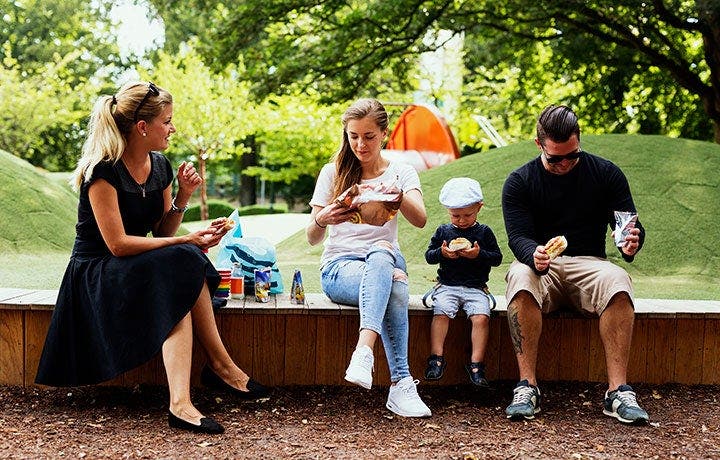
All parents have felt the hot shame of having a friend or relative judge their parenting skills. It never feels good—and when it comes to the food you’re feeding your kids, there can be added layers of guilt and confusion on top of it.
Do you buy the hot lunch at school for your children rather than prepare a homemade feast for them every morning? Or maybe you allow the consumption of “controversial” ingredients like gluten or don’t follow a strict non-GMO or organic policy. Suddenly, the healthy meals you believe you’re providing your child—in whatever way—are called into question. And you’re left wondering what to do next.
Some people can simply shrug it off. The rest of us cannot. Social acceptance—and that feeling of belonging to a group or tribe—is one of humanity’s most primitive survival skills. True, being judged for the contents of your kid’s lunch box won’t result in you being attacked by a saber-toothed tiger today (which is long extinct, thank goodness), but that bitter feeling of rejection can cause aggression, anger, sadness, jealousy, and hurt feelings. Research published in the Journal of Personality and Social Psychology found that social rejection can even undermine your impulse control. In the study, socially rejected people ate more than twice as many cookies as non-rejected people, but consumed only one-third as much of a bad-tasting but healthy beverage. Great—being judged for what you feed your kids might drive you to make poor food choices for yourself. That’s a lose-lose.
There is an alternative, of course. Don’t let the food bullies get you down.
Build Your Parenting Mettle
Understand where the judgment comes from.
“The future is uncertain. But people love their kids very much, and they are so afraid of something bad happening to their kids that they can’t tolerate that uncertainty,” explains Barbara Sarnecka, PhD, an associate professor of cognitive sciences at the University of California, Irvine, and a parent herself. “They want to adhere to some set of rules that will make everything turn out okay.” If you break the rules another parent desperately wants to believe in, it can terrify that person. When you understand that other parents are judging based on their own fear and insecurity, it’s a little easier to have compassion for them.
Find like-minded friends.
Striving to identify and form bonds with new friends is one way parents might cope with exclusion. A small taste of acceptance from the class parent who doesn’t bat an eye upon learning that your kid still eats chicken nuggets may be enough to drive away the shadow of more judgmental peers.
Talk about food choices.
The simplest thing to do when faced with a judgy parent is talk to them, says Wesley Delbridge, RD, a national spokesperson for the Academy of Nutrition and Dietetics. “Start a conversation about how your family handles food and nutrition,” Delbridge explains. “You want to foster understanding but also make it clear—in the nicest way possible—that you make the decisions for your family, whether they approve or not.” (And if you’re getting the side-eye for ordering the school lunch, feel free to share this information: A study by Virginia Tech researchers published in the Journal of Nutrition Education and Behavior concluded that packed lunches compared to school lunches were of less nutritional value.)
Also important: Talk to your children. “You should be discussing food and food decisions all the time,” says Delbridge. “Make everything a teachable moment, and show kids that making healthy choices can be a struggle and sometimes your choices aren’t popular with other people. That’s authentic living.”