What to Know Before Your First Cardio Boxing Class
Want to get fit and strong? Try this fitness punch.
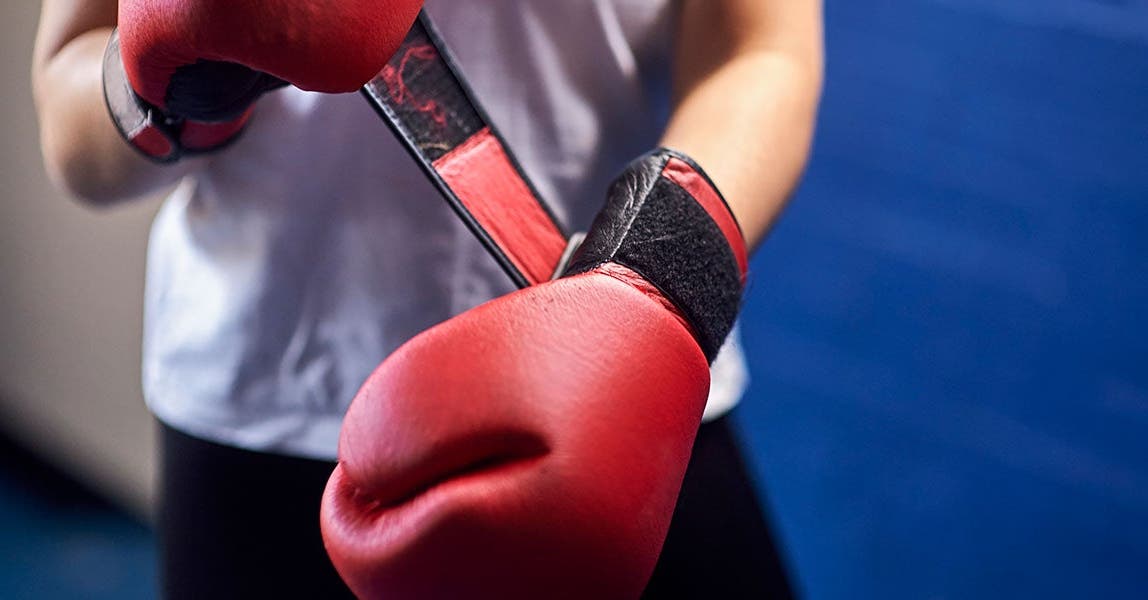
Ready to learn how to pack a powerful punch and shed some pounds? Anyone can reap valuable fitness rewards from a fighting regimen. Follow these simple steps.
Step 1: Find a Class
From Power Boxing and Turbo Kick Boxing to Mixed Martial Arts (MMA), class names can be confusing at best and intimidating at worst. But actually, the difference between boxing and kickboxing is simple, says Jessica Penne, an LA Boxing trainer and top-ranked professional women’s MMA fighter. “In boxing, you only use your fists; in kickboxing, you use your feet, knees, elbows and punches,” says Penne. “While boxing uses a lot more upper body, kickboxing is a full-body workout.”
Whether you’re more interested in punching or kicking, Penne recommends taking different classes and even trying various gym locations and times, because class size and participants will differ.
“That’s why I love this workout,” she says. “There really is something for everyone — men and women, kids and adults." Plus, she notes, you can go at your own pace and make it as easy or challenging as you want it to be.
Step 3: Learn the Moves
If the first thing you think of when you hear the word boxing is full physical contact and brute force, have no fear. For the most part, the hardest thing you’ll hit is a punching bag.
“In a cardio boxing class, you’ll follow a format that will take you through a warm up, where you’ll do things like shadow boxing – not making contact with anything – jumping rope, and footwork drills like sidestepping, pivoting on the balls of your feet, and practicing ladder patterns on the ground,” Penne explains. “Then you’ll move on to punching combinations on the bag or hand mitts and end with a cool-down of ab exercises and pushups.”
If you are right-handed, you’re orthodox; and if you are left-handed, you’re southpaw. Your starting position always has your fists at your jawline, ready to protect. Your stance should be feet shoulder-width apart, your non-dominant hand and foot forward, and knees slightly. You should have your left leg forward if you’re orthodox, right if you’re southpaw.
Punching combinations include the four most basic punches:
Jab: (See top left illustration below) Use your less dominant hand to punch forward. Orthodox uses the left hand; southpaw uses the right. This is your weakest punch.
Cross: (See top right) This is your power punch. You use your dominant hand to punch forward.
Hook: (See bottom left)The same hand use for your Jab crosses your body.
Uppercut: (See bottom right) Your dominant hand punches up.
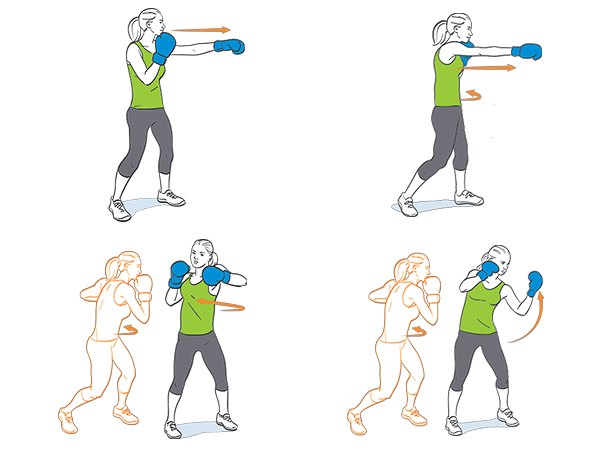 “Think of your jab as your distance gage from your target and your cross as a straight punch from your power hand,” Penne says. Your hook is a semicircular horizontal punch with your elbow bent at a 90-degree angle, while your uppercut is a rising vertical punch. “You can hook or uppercut from both sides and they can be equally powerful.”
Like any new sport, there’s a lot to learn, but Penne assures that a class environment is designed to make newcomers feel comfortable.
“Don’t worry about going into your first class not knowing anything,” Penne adds. “The instructor will take you through the technique, and you’re never going along all by yourself.”