20 Fitness Instructor Cues, Translated
We asked instructors of fitness classes from barre to Zumba to explain their most popular cues.
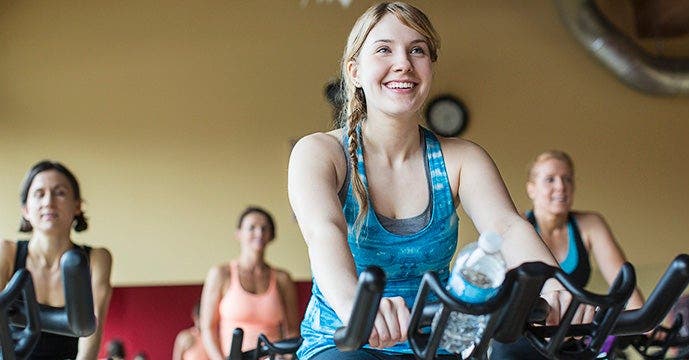
Trying a new type of fitness class is a perfect way to keep your workout from getting stale. But, stepping out of your comfort zone into a new class can be intimidating. Don’t worry, the instructors are there to help guide you through the workout using cues.
“Cues are important because they allow the instructor to communicate with the clients using only a couple, specific words,” explains Noam Tamir, CSCS, founder of TS Fitness in New York City. “Cueing can also help with the efficiency of exercises, and it’s a great way to have clients check in on their form when they get tired.”
We asked instructors from all different group fitness classes to share the most popular cues and what they mean, so you know what you’re getting into before walking in the studio or gym door.
RELATED: All About Fitness Classes
Barre
1. Tuck your pelvis
Expect to hear this a lot during this class, mostly when you’re standing at the barre, to engage your middle muscles. “Tucking your pelvis, or the cue to ‘tuck your hips’ helps you to both activate your core and find a more neutral lumbar spine,” says Rachelle. A Reed, PhD, instructor at Pure Barre in Denver. “Think of pulling your navel in as you rotate your hip bones up toward your rib cage.”
2. Down an inch, up an inch
When I dip, you dip, we dip? Not quite. This movement is a lot smaller and more controlled, targeting the thigh muscles. “It helps clients to realize how small the movement is supposed to be—the size of a paper clip!” says Reed. “The isometric work throughout a barre class, like ‘down an inch, up an inch,’ is designed to help isolate large muscle groups and bring them to the point of complete, shaky fatigue pretty quickly.”
3. Pulse
Don’t worry—you’re not checking your pulse to see how hard you’re working (though you can if you want to!). Pulsing is an even smaller movement than down an inch, up an inch, and you only perform it in a downward direction. “The pulse is built around the principle of isometric work, which isolates the target muscle a specific exercise is designed to fatigue,” explains Reed. “By keeping the rest of the body still and strong, and only pulsing at the joint supporting your target muscle, you are able to quickly fatigue the target muscle. On the other hand, traditional exercise movements like squats involve larger ranges of motion, multiple joints and multiple muscle groups.”
Indoor Cycling
4. Turn up the resistance
A cue that means exactly what it says—turn that resistance knob up. “Turning up the resistance is what makes us strong and powerful,” says Amanda Margusity, instructor at Crank NYC indoor cycling studio in New York City. “The more resistance, the bigger the burn. But resistance is also for safety. When you do not have resistance on, the flywheel controls you and you will get that ‘Oh, no, I can't control my body feeling!’ Resistance is your friend.”
5. "4, 3, 2, 1"
This countdown brings you into the next portion of movement in Spin class. “In beat-based riding, we love the countdown because it means a beat change or beat drop,” says Margusity. “This cue helps to end any confusion a rider might have about what's happening in class.”
6. Out of the saddle
This means to stand up and pedal. Basically, it is the cue telling you that it is time to get your butt off the seat. This normally occurs when you are simulating biking up a hill.
7. Isolate the body
When you isolate in an indoor cycling class, you’re out of the saddle and it means you’re going to take the bounce out of your ride, therefore isolating or using just your lower body. “You activate the muscles even further by squeeze your glutes, removing any bounce, and staying on an imaginary center line, not rocking side to side,” says Margusity. “It’s very focused on activating the glutes and quads.”
RELATED: Know Before You Go: Group Cycling
Pilates
8. Engage your pelvic floor
You’ll hear this at least once during both mat and reformer classes as it’s important for many different core exercises. “Our transversus or inner core girdle [muscles surrounding the body’s midsection] starts with the lift of the pelvic floor muscles, so we need to consciously engage the pelvic floor,” explains Kristin McGee, celebrity yoga and Pilates instructor.
9. Breathe into the back of your body and the sides of your waist
This cue is all about directing your breath and energy to help use it during class. “In Pilates, we are keeping our core strong so we need to direct the breath into the sides and back body and be sure we’re not inflating the abdominals,” explains McGee. “When the abdominals are inflated, they’re not being used correctly.”
10. Heel together, toes turned out
It may remind you of ballet class, but it’s an important position in Pilates, too. “This is Pilates V stance and we use it to find the inner thighs and pelvic floor connection,” says McGee.
RELATED: Know Before You Go: Pilates Studio