The Weigh In: Susie Banikarim on why she’s rejecting the shame propaganda around GLP-1s
Susie Banikarim unpacks the mental weight women carry around taking GLP-1s with her close friend and host Samhita Mukhopadhyay.
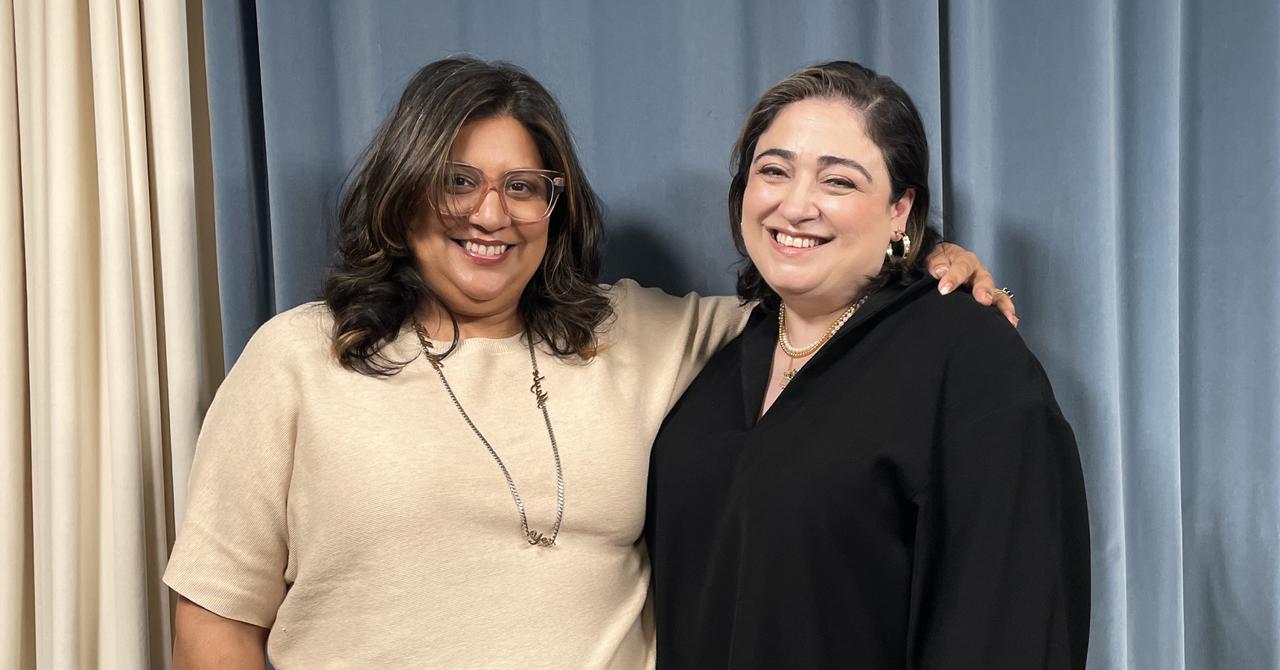
This week’s conversation with Susie Banikarim — Emmy-winning journalist, documentary filmmaker, podcast host, and one of Samhita's closest friends — is personal. It’s about how two successful women supported each other’s GLP-1 journeys at a time when intentional weight loss became something to hide. It’s also about the experience of being overweight on both sides of the camera, why taking GLP-1s is not cheating, and why Banikarim would “rather just go through the world…blissfully feeling good.” Watch the episode above, listen in on your preferred podcast platform, or read the highlights from the conversation below.
These are the kinds of real, honest questions — and much more about weight, health, and GLP-1s — you’ll find being discussed on The Weigh In, a new weekly podcast from Weight Watchers. It’s hosted by Samhita Mukhopadhyay, a journalist, author, and head of content at Weight Watchers. (As always, this is for education purposes. Talk to your doctor for questions about your health
On refusing to shame herself
“I had already gone through a process with [mental health] medication where I was like, ‘I need this, but I feel like I should be able to power through this.’ [Yet] I would never shame someone for needing an asthma inhaler. To shame myself for needing mental health medication or…weight-loss medication is ridiculous. Medical intervention is required for some medical issues, and I think it's a very American thing to feel like we should be able to solve every problem by the sheer force of our will. That's just not realistic.”
On the willpower propaganda she’s not falling for
“I've tried starving myself. I've tried eating only grapefruits and eggs. I'm a woman of a certain age in America. This idea that [taking a GLP-1] is like cheating is so crazy to me. What am I cheating? Who am I cheating? Cheating implies there's a loser in the scenario. I don't get that. I'm not willing to accept that. That's propaganda I'm not falling for.”
On getting healthy, but not thin
“You're so hard on yourself when you feel overweight. By the time I gained [a lot of] weight, it was clear that it was [because of] a medical condition. I'd never had this thing where doctors constantly told me to lose weight. I had an endocrinologist. I worked with her on… getting my hormones in balance. It was never, ‘How can we get you thin?’ It was, ‘How can we get you healthier?’ I take, at this point, a pretty low dose. [We] joke about the fact that we're the only people on GLP-1s who didn't get super skinny... because that was never really the goal.
The truth is… doing a full dose [of medication] I did have a lot of symptoms. I did have projectile vomiting occasionally. I would get really nauseous, and I really lost an appetite for food. Food just became kind of gray and dull to me. It’s a source of pleasure in my life I'm not looking to eliminate. So I have found a place that feels healthy and right for me. We can all make our own decisions about what we need, and it's not supposed to be everyone's business.”
On not losing a “breathless amount of weight” on a GLP-1 and being comfortable in her own skin
“Of course that’s tempting. That is the sort of temptation I've had my whole life. I could also have starved myself if that was really a goal for me. And that's just not the goal for me. For me, I think it's: am I comfortable in my body? Am I feeling good about my health? Am I at least at a weight where I feel comfortable in my skin? And that's really what I'm aiming for. That's part of just getting older. I'm just less concerned about how other people see me physically. I have…the opposite of traditional body dysmorphia. Anytime I see a picture of myself, I’m like, ‘Who is that? I am way cuter than whatever this is.’ I would rather just go through the world…blissfully feeling good about myself. I don't need…external feedback. I'm good.
I spent so many years worrying about my weight– from the thinnest I ever was to the heaviest I ever was. It's not like I've completely shut down that noise in my head or I don't have it, but I definitely got to a point in my life where it stopped carrying so much weight for me. It was so central to my identity for so long. It was the reason I felt really unlovable. I felt like, ‘Oh, you know, if only I could fix this thing about myself, it would fix everything about me.’ My career would be perfect. I'd have the perfect boyfriend. I'd have the perfect life. That's just not a reality. There's no such thing as, like, a panacea.”
On not being in the public eye as a plus-sized newscaster
“[Being overweight has] never been part of my public identity. I run newsrooms. If anyone had ever brought up my weight, they probably would've gotten fired. Part of the reason I never wanted to be in front of the camera is I never wanted to be evaluated just on the way I looked. But I did once watch a female anchor…in a meeting. Someone who worked for her reached for some M&Ms, and [the anchor] smacked her hand away. And she was like, ‘You don't need those.’ Now, no one ever did that to me because that would've been the last time they touched me.”
On the idea that GLP-1s are ‘vanity drugs’
“For all the stigma in this country around being overweight…people are more put off by people who lose weight with these medications.
Something…happened when [GLP-1s] entered a celebrity space. It became seen as…elitist. I just never had that relationship to [the medication]. I took it, my insurance covered it. It was clearly for a medical reason. [Later] it became seen as a designer thing, right? Like, as a shortcut. Like, ‘oh, you're rich and you're getting to do this. You're…doing a trick, like a magic trick.’ That is such a small reality in terms of the people this medication actually helps, the people who are pre-diabetic or diabetic who have real medical issues. We're working now as a culture to kind of reorient ourselves around what these drugs actually mean.”
On intentional weight loss
“Everybody, everyone can do whatever they need to feel good in their life. For the same reason I would never suggest a woman lose weight if she was happy and comfortable in her skin, I'm not going to tell a woman she's not allowed to lose weight either. For the same reasons that I just choose to support women where they are in their journey, as happy as they can be in the process. I just want everyone to feel okay…in the skin they're in.
Wouldn't it be nice if girls could just grow up feeling like they could just make their own decisions about what does and doesn't work for them, and they could see representation? I think what's so important about this era is that we see the representation of people who are very thin and very overweight, and all of those things are fine. And you can see someone who dresses really cute who's overweight. You see in the culture people who have varied bodies, and you can see that and be like, ‘Oh, I can be that even if I'm not the thinnest person on the scale.’”