Considering Mounjaro and Ozempic? Here’s what to know
These two GLP-1 medications can both help you manage your type 2 diabetes, but there are a few key differences.
)
In this article:
- What is Ozempic?
- What is Mounjaro?
- The key difference between Ozempic and Mounjaro
- Mounjaro vs. Ozempic, side by side
- Mounjaro vs. Ozempic for weight loss
- Mounjaro vs. Ozempic uses
- Mounjaro vs. Ozempic dosages and administration
- Effectiveness of Mounjaro vs. Ozempic
- Mounjaro vs. Ozempic cost and insurance coverage
- Mounjaro vs. Ozempic side effects
- Can you switch from Ozempic to Mounjaro?
- How Weight Watchers can help
- The bottom line
When considering which GLP-1 medication to take, such as Mounjaro vs. Ozempic, you need to dive down into the details. That’s because while these medications are pretty similar — they both can manage blood sugar and are FDA approved for type 2 diabetes — they aren’t identical. They have different active ingredients, different dosages, and different impacts on your blood sugar control (hemoglobin A1c). One big thing they have in common? Both may lead to weight loss, but they aren’t FDA approved for that purpose.
If you're weighing Mounjaro vs. Ozempic for your diabetes management, here's how they differ and why the distinctions matter when it comes to your health.
Key takeaways
Mounjaro (tirzepatide) and Ozempic (semaglutide) are both once-weekly injectable GLP-1 medications FDA approved to manage type 2 diabetes. Ozempic is also available as a daily pill.
The key difference is that Ozempic mimics one hormone (GLP-1) while Mounjaro mimics two (GLP-1 and GIP).
In head-to-head research, Mounjaro tends to produce greater A1c reduction and more weight loss than Ozempic.
Which is "better" is an individual decision best made with your clinician — people respond differently to medications and your personal health history and goals are important.
What is Ozempic?
Ozempic is a brand name for the GLP-1 medication semaglutide that's been approved by the FDA for type 2 diabetes management. It works by mimicking GLP-1 (glucagon-like peptide 1), a hormone that your body produces naturally whenever you eat. This hormone signals the pancreas to release insulin as a way to control blood sugar.
GLP-1 medications like Ozempic also slow the rate of stomach emptying, which not only further improves insulin resistance, but also helps you feel full for longer, according to Dr. Sue Decotiis, M.D., a board-certified obesity specialist in Scarsdale, NY. And they also reduce your appetite by targeting certain receptors in the brain. As a result, GLP-1s like Ozempic help you lose weight.
What is Mounjaro?
Mounjaro is also a GLP-1 medication that is approved for type 2 diabetes management, but it contains a different drug: tirzepatide. This drug mimics two hormones: GLP-1 and GIP (that one stands for glucose-dependent insulinotropic polypeptide). Like Ozempic, it can affect the pancreas for blood sugar regulation, delay gastric emptying, and target receptors in the brain to reduce your appetite.
The key difference between Ozempic and Mounjaro
What really separates Ozempic from Mounjaro is that Ozempic only contains a GLP-1 while Mounjaro has both a GLP-1 and a GIP.
"This is the main difference because these are hunger hormones, and both increase feelings of fullness," says Dr. Jill Blickley, D.O., a board-certified specialist in internal medicine and obesity medicine and senior clinician lead at Weight Watchers.
GLP-1 slows down how quickly the stomach empties, which increases satiety, she adds. GIP doesn’t work on its own as a type 2 diabetes medication, but when paired with GLP-1, the combination helps to further suppress your appetite, reduce visceral fat accumulation in the belly, and improve nausea (a side effect of GLP-1s that can stop people from increasing their dosage). "Because Mounjaro acts on two hormones instead of one, it tends to work a bit better,” Blickley says.
So while Ozempic and Mounjaro have the same effect — better blood sugar management and weight loss — the extra hormone mimicked by Mounjaro tends to improve these effects.
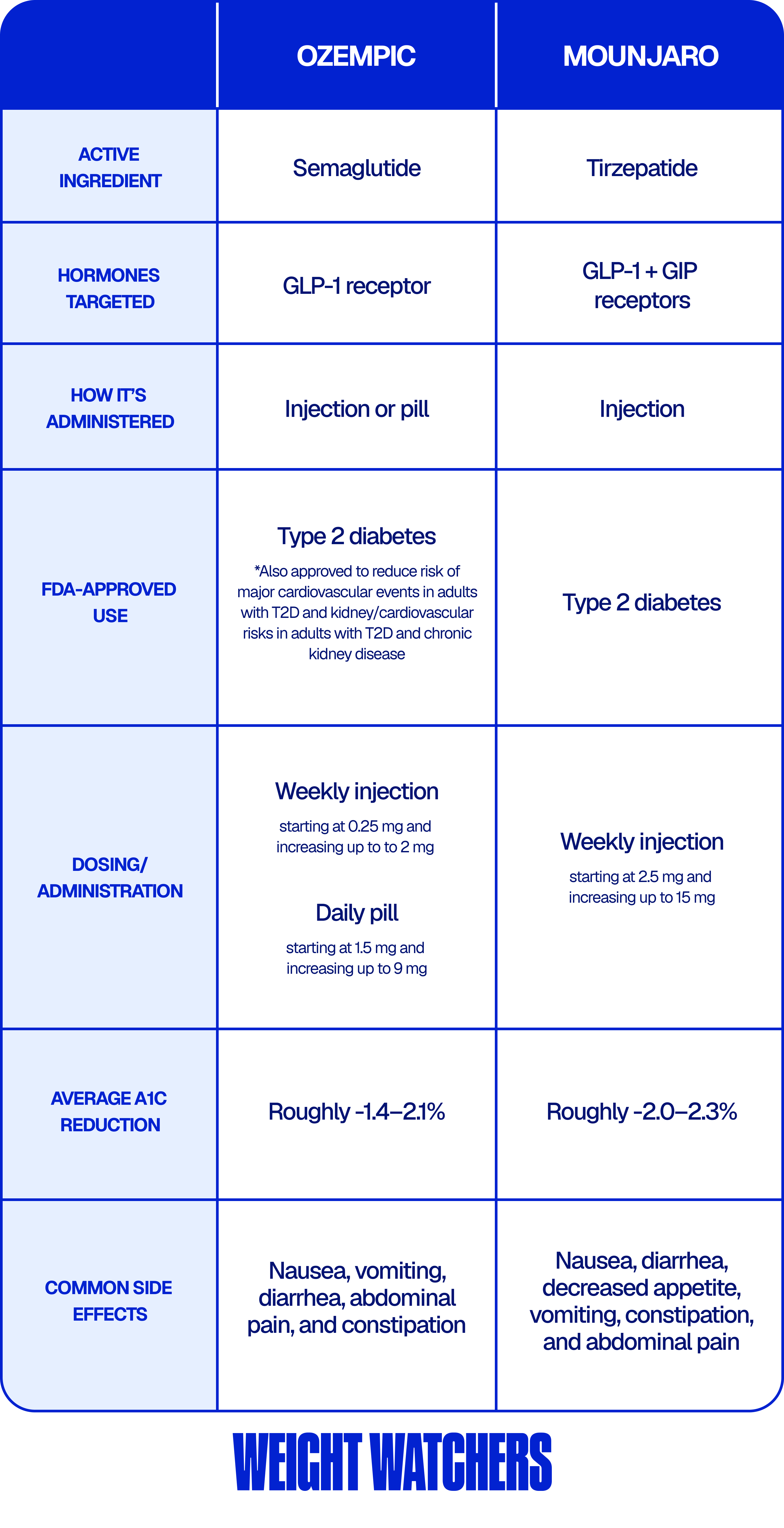
Mounjaro vs. Ozempic, side by side
Mounjaro vs. Ozempic for weight loss
Although both Mounjaro and Ozempic are prescribed for type 2 diabetes control, both Mounjaro and Ozempic can produce some weight loss. Mounjaro tends to produce a higher weight loss than Ozempic. This is likely due to the fact that it mimics two hormones that can help with increasing feelings of fullness, says Blickley.
In research, patients with type 2 diabetes on a 2.0 mg dose of Ozempic lost an average 6.4% of body weight (around 14.1 lbs) over 40 weeks. In another study, patients with type 2 diabetes on 15 mg of Mounjaro lost about 14.7% of body weight (around 32.6 lbs) over 72 weeks. In both studies, use of the medication was paired with diet and exercise.
While Mounjaro and Ozempic are not approved for weight loss, other medications are. These include Wegovy (semaglutide), Zepbound (tirzepatide), Foundayo (orforglipron), and Saxenda (liraglutide).
Mounjaro vs. Ozempic uses
Both Mounjaro and Ozempic are FDA-approved to help regulate blood sugar in those with type 2 diabetes. The active ingredients in both, however, have been found to have other health benefits: Ozempic has also been approved by the FDA for lowering risk of major cardiovascular events like heart attack and stroke, as well as reducing the risk of kidney function decline. And tirzepatide, the medication in Mounjaro, has been shown to help improve sleep apnea.
Mounjaro vs. Ozempic dosages and administration
Both medications are administered as weekly injections using a pre-filled pen that you give yourself at home. For Mounjaro, the recommended starting dose is 2.5 mg and it goes up in 2.5 mg increments: 5 mg, 7.5 mg, 10 mg, 12.5 mg, and 15 mg. With Ozempic, the starting dose is 0.25 mg, with higher doses of 0.5 mg, 1.0 mg, and 2.0 mg available. Ozempic is also available in pill form that you take daily. It comes in 1.5 mg, 4.0 mg, and 9.0 mg doses.
In most cases, dosage for both Mounjaro and Ozempic is increased every four weeks until the maximum dosage is reached. However, some patients may remain at a lower dosage long-term if it seems to be working well for them, Decotiis says.
Effectiveness of Mounjaro vs. Ozempic
Both of these medications can enhance long-term health, says Decotiis. That's because managing type 2 diabetes can lower certain health risks associated with elevated blood sugar, like kidney damage, poor blood vessel function, and bone and joint problems.
That said, Mounjaro does seem to cause a bigger improvement on A1c, a measure of blood sugar. In a head-to-head clinical trial, 15 mg of Mounjaro lowered A1c levels by an average of 2.3 percentage points while 1 mg of Ozempic lowered them by 1.86 percentage points. (It’s worth noting that the study did not look at Ozempic’s maximum dose.) Another study showed that 2.0 mg of Ozempic can bring A1C down 2.1 percentage points — more than 1.0 mg of Ozempic, but still less than the maximum dose of Mounjaro.
Again, both medications also result in weight loss, but tirzepatide (the active ingredient in Mounjaro) edges out semaglutide (the ingredient in Ozempic). In people without diabetes, 15 mg of tirzepatide resulted in an average weight loss of 20.9% after 72 weeks while 2.4 mg of semaglutide resulted in an average loss of 14.9% after 68 weeks.
Mounjaro vs. Ozempic cost and insurance coverage
If you’re paying out of pocket, Mounjaro's retail price is $1,112 for a one-month supply while Ozempic costs $1,027.51. You may be able to find discounts, however. For example, Mounjaro’s manufacturer, Eli Lilly, offers a savings card, and those who are eligible might pay as little as $25 for a one-month or three-month prescription.
The good news is that many commercial insurance companies will cover these medications for type 2 diabetes management (whether or not yours does depends on your exact plan). For Ozempic, some plans may require documentation showing a failure to achieve improvements in A1c with certain other diabetes medications before approving it, says Dr. Allison Rhodes, M.D., a board-certified obesity specialist at The Ohio State University Wexner Medical Center. For both Ozempic and Mounjaro, plans may not cover them if they’re prescribed off-label for weight loss.
Mounjaro vs. Ozempic side effects
Much like any medication, both Mounjaro and Ozempic may cause side effects. They are most often mild and are usually felt when starting the medication or when increasing the dosage. That said, more serious but less common side effects can occur with both Mounjaro and Ozempic, including pancreatitis, gallbladder disease, and worsening of diabetic eye disease. And those with a personal or family history of medullary thyroid cancer or multiple endocrine neoplasia type 2 should not use them.
Ozempic side effects
Common side effects listed for Ozempic include:
Nausea
Diarrhea
Vomiting
Constipation
Abdominal pain
Find the complete list of side effects on the Ozempic manufacturer site.
Mounjaro side effects
Common side effects listed for Mounjaro include:
Nausea
Diarrhea
Vomiting
Constipation
Abdominal pain
Find the complete list of side effects on the Mounjaro manufacturer site.
Can you switch from Ozempic to Mounjaro?
Yes, if one medication is not working well for you, it's possible to switch to the other, says Rhodes. For example, you may be experiencing side effects with one of them and wish to try the other to see if you tolerate it better. If switching, your clinician will come up with the right approach, timing, and dosage that’s tailored to your needs, making sure to balance side effects and efficacy throughout the transition.
How Weight Watchers can help
Whether you're taking Mounjaro, Ozempic, or another GLP-1 medication, Weight Watchers offers a breadth of resources and support. Weight Watchers Med+ clinicians can work with you one-on-one to evaluate your health history and goals and determine which, if any, FDA-approved medication is right for you. “Our teams can make sure members understand what's available, the pros and cons of each option, and work together to build the right treatment plan," says Blickley.
Weight Watchers can also help members navigate the insurance issues related to these medications, she adds. You’ll get support with understanding coverage, working through prior authorizations, and figuring out which medication is actually accessible and affordable.
And, unlike with many telehealth services, you’ll also get access to a tailored nutrition program. “The medication is just one piece of the plan, not the whole plan." In addition, members (and non-members) have the option to meet with a Weight Watchers dietitian, which may be covered by insurance. "The registered dietitians through WW are highly knowledgeable about all of these medications, and work closely with members to help minimize side effects and make better food choices," Blickley says.
The bottom line
Both Mounjaro and Ozempic are GLP-1 medications that are FDA-approved for type 2 diabetes management, to be used in conjunction with diet and exercise. Mounjaro is given as a weekly injection; Ozempic is given as a weekly injection or a daily pill. While they have similar mechanisms, Ozempic mimics just GLP-1 while Mounjaro mimics GLP-1 and GIP. As a result, Mounjaro may be more effective at reducing blood sugar than Ozempic. The medication that’s right for you depends on a lot of factors, so your clinician will be able to guide you to figuring out which one might be best for you.