What can you do about hormonal belly fat?
Cortisol, estrogen, and insulin can all promote belly fat — and make it harder to lose.
)
In this article:
You might not be able to actually see the hormones in your body — but they often make their effects known. Think: those faint hairs above your lip, breakouts on your chin…even belly fat. And while you may have come across “cortisol belly” and “hormonal belly” on social media, actually treating hormonal belly fat is rarely as simple as these posts make it seem. There’s no magic tincture you can take to shrink or melt it, but you also don’t have to just grin and bear it — and swear off zippers for the foreseeable future. Abdominal fat isn’t just annoying, it affects your metabolic health and your long-term risk of chronic disease. Here, experts explain what causes this kind of fat, when it’s a problem, and how to actually address it.
Key takeaways
Hormones like cortisol, estrogen, and insulin play a role in storing abdominal fat. This is often called hormonal belly fat.
Abdominal fat is often visceral fat, a type of fat that’s deep in your belly and hugs your organs. It’s an inflammatory fat that can increase the risk for metabolic diseases.
Although you can’t spot reduce fat, habits connected to overall health and longevity can help improve your body composition — your body’s balance of fat mass and lean mass.
If deemed medically appropriate by a healthcare provider, medications including menopausal hormone therapy (for menopausal symptom relief) and/or GLP-1s (for weight management) can be part of a care plan to help reduce hormonal belly fat.
Is “hormonal belly fat” a real thing?
“Hormones play a tremendous role in where we store fat, especially around the abdomen,” says Dr. Shamsah Amersi, M.D., FACOG, a board-certified OB/GYN in Santa Monica, CA specializing in perimenopause and menopause. Various hormones — including cortisol, estrogen, and insulin — affect how your body burns and stores fat, she says.
While hormones are one factor in belly fat, though, they’re not the deciding one. It can be difficult to parse out the exact cause of abdominal fat, though life stage and health conditions like polyendocrine metabolic ovarian syndrome (PMOS) or diabetes can be indicators that hormones are at least partially in play. Identifying hormonal issues and lifestyle habits that may be behind an increase in belly fat can help you make the changes that will improve it.
Why belly fat is different than other fat
We think about fat as one thing — but body fat functions differently depending on the color and where in the body it’s stored. Subcutaneous fat, a type of white fat, is fat that lies just under your skin and is distributed throughout the body. Visceral fat, which is also a type of white fat, is found deep in your belly and hugs your internal organs. Also known as belly or abdominal fat, visceral fat is associated with inflammation and has been connected to the development of cardiovascular disease and diabetes, among other conditions.
The 3 main drivers of hormonal belly fat
In the right amounts, these hormones are your friends — they’re necessary for a healthy body with important functions like stress regulation, blood sugar management, and proper reproductive health. When your levels are either higher or lower than is healthy for your body, however, these hormones may prompt your body to store more abdominal fat. Here’s what’s going on.
Cortisol: the stress driver
Stress and cortisol go hand in hand. And although we often talk about cortisol in a negative light, it’s an important hormone that does more than just regulate your stress response. It also plays a role in metabolism, inflammation, blood pressure, and your circadian rhythm. Still, it’s cortisol’s role as a stress regulator that’s tied to belly fat.
“Physiologically, if your body is stressed, your cortisol levels go up and your body holds onto fat,” says Dr. Ronni Farris, M.D., FACOG, an OB/GYN and certified menopause practitioner in Norman, OK. This was great in times of famine because it was a life-preserving measure, she says, but troublesome today when we’re chronically stressed. We were designed to have short spurts of elevated stress — not the all-day kind — and that relentless stress prompts the body to store fat and make it difficult to lose, she explains.
Estrogen: the menopause driver
As your body marches toward menopause, estrogen begins to decline. That’s when women start to notice menopause weight gain. “Falling estrogen changes how your body distributes fat,” says Farris, noting that it shifts from the legs to the abdominal region. Estrogen promotes healthier subcutaneous fat and protects metabolic health. So when it drops, visceral fat — and the waistline — grows.
Along with developing more abdominal fat, muscle loss that occurs with age that can further promote weight gain. Menopause symptoms like trouble sleeping can also drive up cortisol levels, increasing the likelihood of depositing even more belly fat. (See a pattern here?)
Insulin: the blood-sugar driver
Insulin is a hormone that regulates your blood sugar. When you eat, your pancreas releases insulin, which “opens up” your body’s cells and pushes in blood sugar, where it’s used for energy.
When blood sugar is chronically high, though, you can develop something called insulin resistance — often seen in prediabetes, type 2 diabetes, and PMOS. This means your body can’t properly respond to insulin, so blood sugar can’t get into your cells. “When someone is insulin resistant, the body is more likely to store excess calories as visceral fat around the abdomen,” says Amersi.
How to tell which hormone is likely driving your belly fat
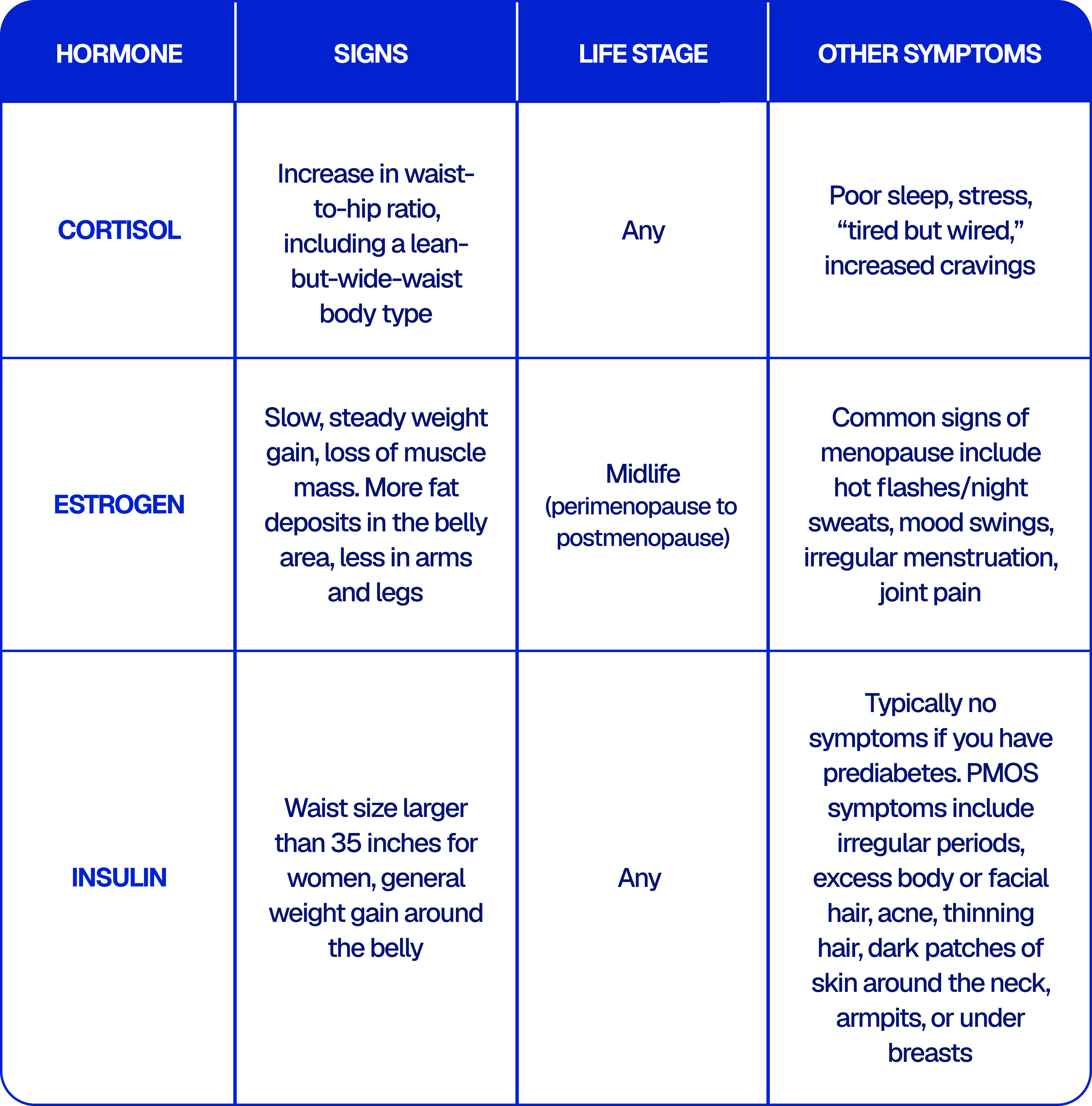
Only a clinician can evaluate you for chronic stress, tell you that you’re in perimenopause, or diagnose you with prediabetes, type 2 diabetes, or PMOS. Still, there are some clues that hormones might be behind your belly fat. Keep in mind that more than one of these can affect you at the same time.
What actually helps
Often, there’s a combination of factors leading to belly fat, and so you won’t necessarily address each one in isolation. Luckily, many of the lifestyle changes that clinicians recommend address each of these and help with the overall goal of losing hormonal belly fat.
It’s also important to talk to a clinician about what's going on rather than trying to jump into a restrictive diet: “I encourage patients to look beyond calories alone. If someone is eating well and exercising but continues to gain abdominal fat, it’s important to evaluate the underlying hormonal and metabolic picture,” says Amersi.
If it’s cortisol
Prioritizing good, high-quality sleep, stress management, and exercise can all help lower your stress. Strategies like practicing mind-body therapy, mindfulness, relaxation, or talk therapy have been found to be effective in lowering cortisol levels, according to a review and meta-analysis in Psychoneuroendocrinology.
If it’s estrogen
If what you’re seeing may be menopausal belly fat, focus on strength training and protein, manage menopausal symptoms, and talk to a clinician about whether hormone therapy is right for your menopausal symptom management.
"Menopausal hormone therapy is not a weight-loss medication, but it can help with some of those body changes in midlife," says Farris. It might do that by helping prevent body fat increase and the shift to more abdominal fat, per research. Additional research suggests that the combination of hormone therapy and GLP-1 medications can be more effective for weight loss compared to when they're used alone.
If it’s insulin
A diet focusing on protein and fiber is key for blood sugar management to maintain healthy insulin function and address insulin belly fat. Exercising improves insulin sensitivity, and short walks after meals have been found to reduce the rise in blood sugar after eating. If you have insulin resistance or prediabetes, lifestyle management and weight loss can reduce the risk of developing type 2 diabetes. If you have other signs of PMOS, seek an evaluation from your healthcare provider.
What helps across the board
Unfortunately, you can’t spot reduce fat. The good news is that the foundational habits that are connected to overall health and longevity are also effective for improving your body composition and reaching a healthy-for-you weight. That includes eating a moderate, calorie-reduced diet that’s rich in protein and fiber, strength training to preserve and build muscle, getting adequate sleep, and practicing stress management.
When it comes to abdominal fat, there isn’t just one thing you’ll focus on — you’ll need a well-rounded approach. “Treating insulin resistance, optimizing hormones when appropriate, improving sleep, and reducing chronic stress can all make a meaningful difference in body composition, not just the number on the scale,” says Amersi.
When to see a doctor
If you’re concerned about possible hormonal or metabolic health changes, that’s a great time to see your doctor. “I recommend all women seek an evaluation when they notice a significant change in body composition, especially increasing abdominal or visceral fat, despite maintaining healthy habits,” says Amersi.
Social media can make this seem as if it’s all one hormone’s “fault,” but it’s rarely that simplistic, explains Amersi. “More often, abdominal fat is driven by a combination of insulin resistance, declining estrogen during perimenopause and menopause, loss of muscle mass with aging, poor sleep, and chronic stress working together.”
A clinician will look at your entire picture, including your symptoms, life stage, lifestyle and current challenges, and overall health and metabolic markers to help when you’re struggling with abdominal fat, adds Amersi. In other words, it’s a combination of medical and lifestyle factors that play into belly fat, and working with a clinician can help you put those pieces together and develop a plan.
How Weight Watchers can help
Healthy lifestyle habits are the foundation for feeling good and getting to your goals — and they play a role in improving insulin and cortisol levels, as well as supporting your wellbeing during menopause. Weight Watchers is there to provide personalized targets to hit your protein and fiber goals, encourage an exercise and activity routine that you can stick with, and offer stress and sleep support — and there’s a program that’s tailored to what you’re going through.
The Weight Watchers Core+ Program teaches you the foundations of healthy eating, Weight Watchers Diabetes Program guides you towards the foods and habits that’ll help manage your blood sugar, the Weight Watchers Menopause Program provides access to hormone therapy and helps you prioritize the nutrients you need most as estrogen declines, and Weight Watchers Med+ Program gives you access to GLP-1 medications along with nutrition and lifestyle support for overall health.*
The bottom line
Abdominal fat matters for your health, and your hormones and weight are connected. Visceral fat is a factor in the development of chronic conditions, including diabetes, so understanding the hormonal factors driving your belly fat is important. That said, the problem is rarely just hormonal, and you’ll want to look deeper into what’s going on. “When a woman develops increased visceral fat, especially during times of hormonal transition, she deserves a thorough evaluation of [hormone] and other metabolic factors,” says Amersi.