Let's walk!
Giving yourself space for self-reflection is just one benefit of walking.
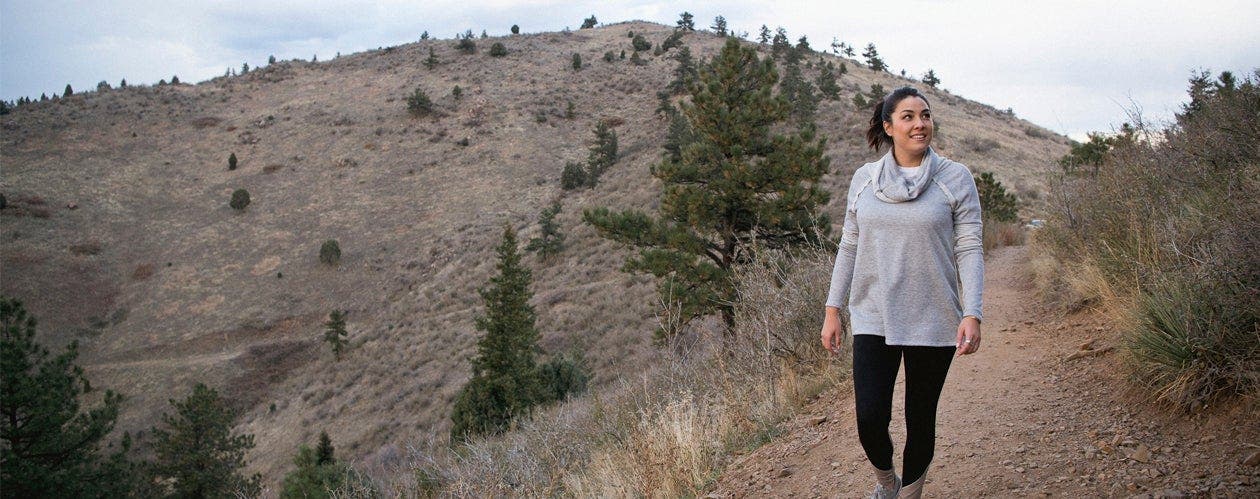
We love walking at WW - it's one of the easiest, most accessible and most affordable workouts you can do.
“Walking doesn’t require any specialised equipment and can be performed anytime, anywhere,” says exercise physiologist Chris Fry from Healthkicks in Cairns, Australia. “Walking is also one of the few forms of physical activity that can be easily implemented into most exercise routines, regardless of your age, gender or exercise history.”
Perth-based exercise physiologist Fiona Ryan agrees that walking has a number of major advantages. “Because it’s low impact on your musculoskeletal system and creates less loading on the joints, there’s much less risk of injury. At the same time, you can vary the intensity of walking from low to moderate, so it’s a suitable option for every level of fitness,” she adds.
Read on for some surprising health benefits of walking, plus a few simple ways to ramp up your walking workout.
Benefits of walking
Walking is a great way to boost your health and help those scales move in the right direction. Here are just some of the benefits:
1. It boosts general wellbeing
“Any form of aerobic exercise has extremely beneficial effects on many chronic disease risk factors, including blood pressure and cholesterol levels,” says Fry. “And the benefit of walking is that it provides all of these health benefits with minimal adverse effects.”
2. It extends your lifespan
According to research from the University of Pittsburgh, the faster you can walk, the better. Researchers found that people who can still cover at least 3.6km in an hour during a walk when they reach the age of 65 significantly increase their chances of living a long, healthy, disease-free life, compared to those people who walk more slowly.
3. It gives you space to think
Going for a walk helps you distance yourself from whatever's going on at home - work stress, busy family life, worries that are weighing you down - and gives you time for self-reflection. This can help you see things from a different perspective, and even come up with new solutions.
4. It helps fight memory loss
Strange, but true! Another study from the University of Pittsburgh discovered that walking at least 9.5km a week can protect brain size and, as a result, help to preserve memory function.
5. It reduces the risk of macular degeneration
That’s according to research from the University of Wisconsin, which found that, when combined with a healthy diet and not smoking, regular walking can help reduce the risk of age-related macular degeneration – a leading cause of blindness – by as much as 71 per cent.
Walking dos and don’ts
Try these handy dos and don’ts to maximise the benefits of your walking workout.
Do… Aim to focus your gaze on the horizon out in front of you or, alternatively, on an object ten or more metres ahead of you, recommends Fry. This will encourage you to maintain a naturally relaxed and healthy neck position.
Do… Remember to keep your bellybutton tightened or tucked in while you walk. “This helps to ensure a degree of control over core abdominal muscles, which helps to minimise any spinal compression that walking might create,” says Fry.
Do… Concentrate on your backside. “Focus on tightening your gluteal (bottom) muscles when each foot touches the ground after a stride for stronger, more toned muscles,” suggests Fry.
Don’t… Overstride. “A really common beginner’s mistake is lengthening your stride in order to walk faster,” cautions Ryan. “Overstriding is actually biomechanically inefficient and can slow you down. It can even cause an injury, so instead of over-striding to increase your pace, think about concentrating on a powerful push-off that allows the foot to land closer to the body.”
Don’t… Tense your upper body. “When you walk, the muscles in your hands and arms should stay relaxed, rather than tightened, to avoid muscle soreness and neck or back tension,” Ryan adds.